
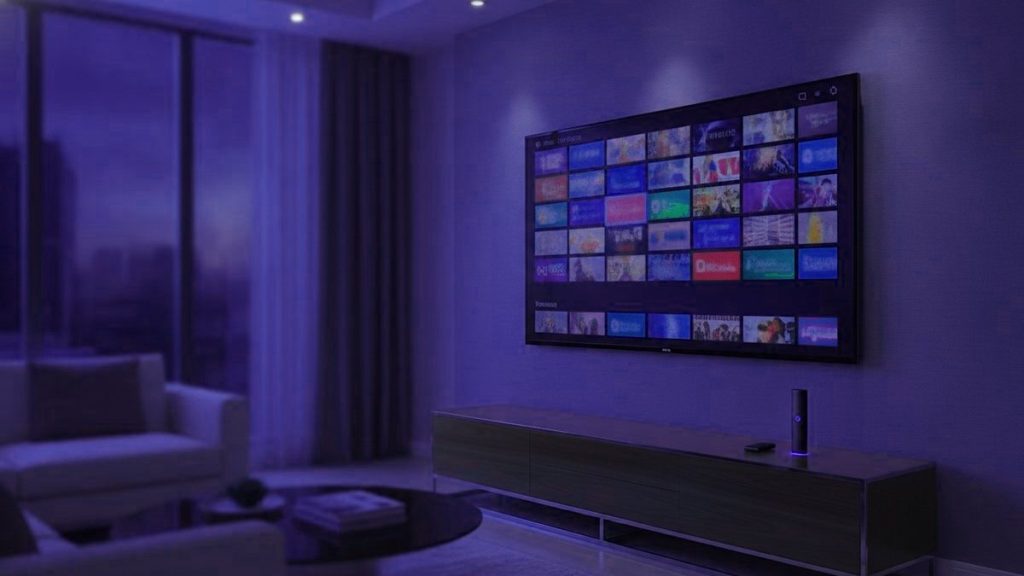
IPTV means your television arrives down the same broadband line you already pay for, rather than through a cable, a satellite dish or a rooftop aerial. A player app signs in with a login from a provider, and the channels come through as data, no differently from a video call. That is the entire idea. What follows is the part that decides whether it replaces your paid-TV stack cleanly or annoys you.
In one sentence
Old-fashioned broadcast fires every channel at every home non-stop. IPTV delivers one channel to one viewer, only when that viewer asks for it. Nearly everything else about how it behaves comes straight from that one difference.
What happens when you press a channel
The player opens a link to a server, and the server starts sending that one channel, sliced into short numbered segments a few seconds each. The app gathers a handful before it shows you anything, keeps gathering as you watch, and plays out of that little reserve.
That reserve is the buffer, and once you picture it most complaints make sense. A full buffer gives a clean picture. When the line hiccups or the server is carrying too many people, the buffer empties faster than it tops up, and the moment it runs dry the picture halts. Buffering is not the channel failing. It is the player standing by for data that has not shown up yet.
Why two homes get different results
Two households on the very same broadband package can have wildly different experiences of one service, and the broadband is seldom the culprit.
- How crowded each server is. An operator racing everyone to the bottom on price rents thin capacity, and it tells the instant a big match starts. Nothing about your kit changed; the queue ahead of you grew.
- Whether channels carry fallback bitrates. A channel offered in 4K, HD and SD leaves you somewhere to step down to. A single bitrate either plays or it does not.
- How far away the server sits. Data crossing an ocean has far more chances to be held up than data hopping across your own city.
- Your line at nine on a dark evening, which bears little relation to the figure printed on your bill.
That is why a Tuesday-morning trial proves nothing. Every provider looks polished with servers half empty, which is exactly why we push people to try one at the busiest possible hour.
It is not the same as Netflix
| Streaming platforms | IPTV | |
|---|---|---|
| What arrives | A library of finished programmes | Live channels on a schedule, plus a library |
| Live sport | Almost none | The main reason people subscribe |
| Breaking news | No | Yes, from many countries at once |
| Programme guide | Not applicable | Yes, a familiar grid |
They fix different problems. A streaming platform stands in for the old video shop; IPTV stands in for the cable or satellite package. That is why the households who switch are usually the ones who were keeping an expensive box on contract mainly for the sport and the news — and often paying for a streaming service and a separate sports pass on top.
What you actually need
A steady connection. Around 25 Mbps for 4K and 10 for HD. Steadiness beats headline speed, because the buffer notices the gaps, not the average. Where the Wi-Fi is thin near the television, a cheap Ethernet adapter cures more grief than any other single change.
Something to run a player on. An Amazon Fire TV Stick, an Android TV or box, a Samsung or LG set from 2016 on, an Apple TV, a Windows PC, or a MAG or Formuler box. There is almost certainly one already in the house.
A player app. IPTV Smarters Pro or TiViMate suit most people. Both start out empty, holding no channels at all until you enter a subscription, which is far and away the biggest cause of first-day confusion.
A subscription. The part that costs money and the part that sets the quality. Everything above is ordinary hardware and free software you probably already own.
The vocabulary
An Xtream Codes login is three pieces: a server address, a username and a password. Most modern players ask for precisely these and sort out the rest on their own. It is the simpler path and the one we hand out by default.
An M3U link is one long web address carrying those same credentials as parameters, meant for players such as VLC and Kodi that expect a playlist file. Guard it like a password, because that is effectively what it is.
The EPG is the programme guide. Keeping it accurate across thousands of channels is dull, never-ending work with nothing to show for it in an advert, which is exactly why whether a provider bothers tells you how the operation is run.
Is it legal?
The technology itself is fully legal and completely ordinary; your phone company most likely runs on it. The question that counts is whether a particular provider holds distribution rights for what it sells, and in this market that is often hard to judge from the outside. Our legality page takes that seriously instead of brushing it aside.
Judging a provider
- A free trial, spent at peak time rather than on a quiet morning.
- Prices shown openly. Having to ask means being quoted individually.
- Refund terms in writing, with a stated number of days.
- Support that replies before you pay. It will not get better afterwards.
- A genuine website. Sellers who live only inside a social account can vanish, and they do.
Ours sit on the pricing page and the trial page, and you should hold us to the same test as anyone else. Once you have a login, the setup guides walk through each device, and getting from payment to your first channel usually takes under fifteen minutes — on the TV you already own, with nothing to send back and no contract to sign.
Frequently asked questions
How does IPTV work in simple terms?
A provider captures TV channels, compresses them into internet-sized video streams and stores them on servers. Your player app logs in with a username, password and server address, asks for a channel, and the server streams it to your device alone. It is the same mechanism as watching a YouTube video, applied to live television.
Is IPTV the same as Netflix or YouTube TV?
Technically they are all television over internet protocol. The difference is that Netflix and YouTube TV are closed services with their own app and licensed catalogue, while an IPTV subscription is an open login that works in any compatible player, with far more live channels. Netflix is never included in an IPTV plan; only titles that also appear on Netflix are.
Do I need a box to use IPTV?
No. Any device that runs a player app works: Amazon Fire TV Stick, Android TV, Samsung and LG smart TVs, Apple TV, iPhone, Android phones, Windows PC and Mac. Dedicated boxes such as Formuler and MAG are optional and mainly offer a nicer remote and guide.
What internet speed does IPTV need?
A steady 8 Mbps handles one HD stream and 25 Mbps handles one 4K stream. For two TVs at once, plan on 30 Mbps. Stability matters more than headline speed, and a wired Ethernet connection to the TV device removes most buffering caused by Wi-Fi.
Why do free IPTV lists stop working?
A free M3U list is one account shared with thousands of people. The server either blocks it or cannot serve them all, so channels die within days and the survivors freeze during popular events. A paid subscription is a private account on servers sized for peak hours, which is what you are paying for.
Is IPTV legal?
The technology is legal everywhere; licensed services such as Hulu, Sling and YouTube TV are IPTV. What matters is whether a provider holds the rights to the channels it carries, which varies. Enforcement in the US targets operators, while some UK and EU viewers have received warnings. Read our legality guide for a country-by-country answer.
One plan, all 25,000+ channels?
Send one WhatsApp message, pay, and your login lands under 15 minutes. Every plan is backed by the 7-day money-back window.
Related articles
Best IPTV Box for 2026: Formuler Z11, Shield or Fire TV Stick
Formuler Z11, Nvidia Shield or a Fire TV Stick 4K Max? The right IPTV box depends on how hard you push it.…
September 4, 2026Best IPTV Apps for 2026: TiViMate, Smarters, Smart IPTV and IBO
TiViMate, IPTV Smarters Pro, Smart IPTV or IBO Player? The right IPTV app comes down to your device. Here is the pick…
September 2, 2026How Much Does IPTV Cost in 2026? A Realistic Breakdown
What IPTV really costs in 2026, set against the cable, streaming and sports bills it replaces, and how to spot a price…